Estimated reading time 20 min 23 sec.
In the summer of 2026, the United States will co-host the FIFA World Cup alongside Canada and Mexico in what is expected to be the largest sporting event in history. With 48 teams competing across 16 host cities, the tournament will generate an unprecedented level of global attention, economic activity, and investment interest throughout the country. For real estate investors focused on Florida, understanding the implications of this event — and positioning accordingly — represents a significant strategic opportunity.
Football, or soccer as it is known in the United States, is the most watched sport on the planet. The FIFA World Cup attracts a global television audience in the billions and draws visitors from every corner of the world. Host cities experience surges in tourism, infrastructure investment, and international visibility that can have lasting effects on local economies and real estate markets. Florida, already one of the most dynamic property markets in the country, stands to benefit in multiple ways from its proximity to and participation in the tournament.
At QKapital, we work closely with international investors navigating the U.S. real estate market. The World Cup represents exactly the kind of global catalyst that creates concentrated opportunity — and investors who understand the dynamics ahead of time are best positioned to act.
Table of Contents
Florida's Role in the 2026 World Cup
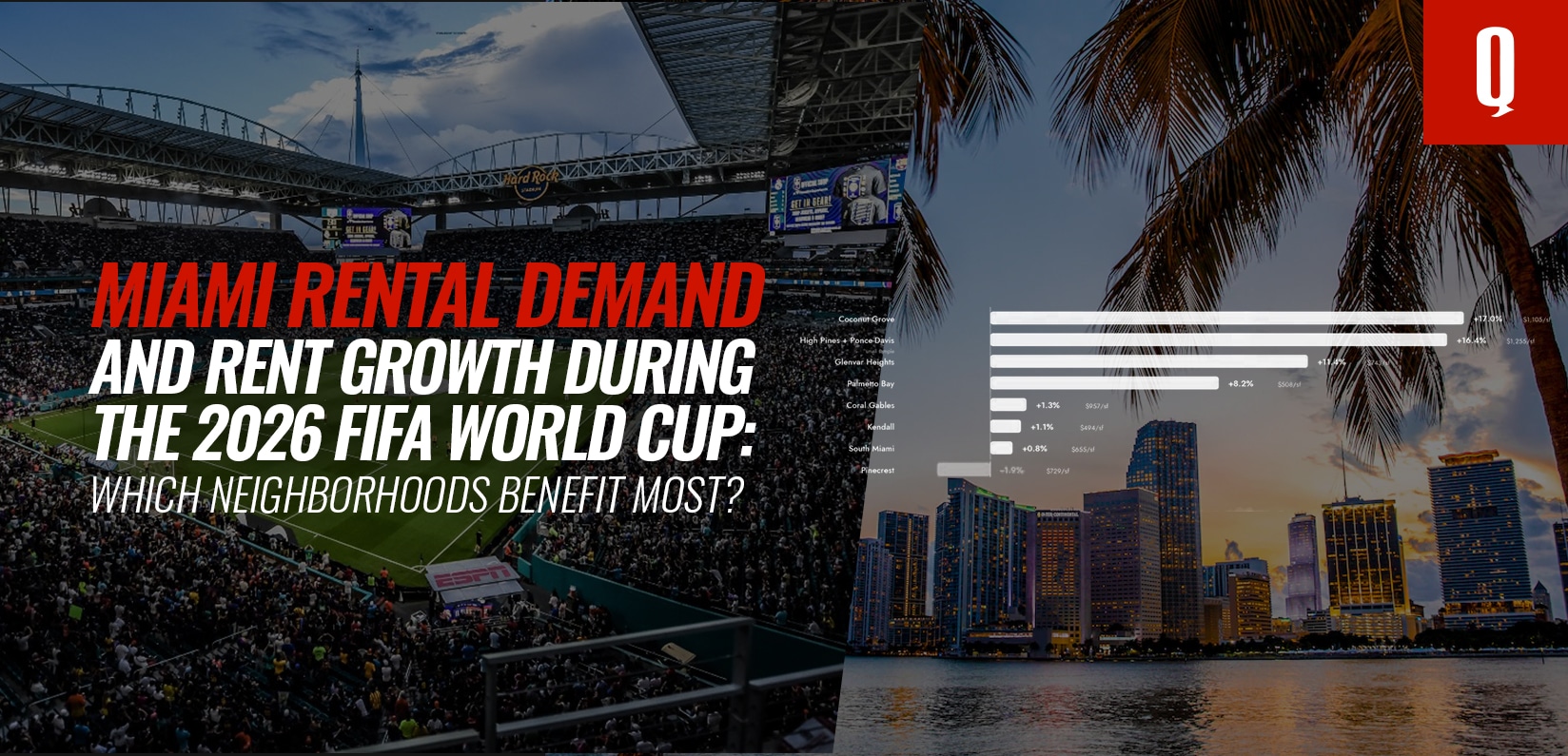
Florida’s position in the 2026 World Cup ecosystem is significant. Miami is one of the confirmed host venues, with matches scheduled at Hard Rock Stadium — the same venue that hosts the Formula 1 Grand Prix. This gives Miami back-to-back global sporting events of the highest order in a single year, an extraordinary marketing and economic achievement for the region.
Beyond the match days themselves, Florida will serve as a major hub for visiting fans, media delegations, and international business travelers throughout the tournament. Miami’s position as the primary gateway between the United States and Latin America means the city will be especially prominent given that South American nations — including Brazil, Argentina, Colombia, and others — are among the tournament’s most passionate participants. The concentration of Latin American visitors expected in South Florida during the World Cup is virtually unmatched by any other major international event.
Orlando, another of Florida’s major real estate markets, will also benefit from its role as a hospitality and fan-experience hub given its extraordinary capacity for large-scale tourism management. The city’s extensive resort infrastructure and transportation network make it a natural overflow destination for visitors exploring the state during the tournament.
Infrastructure Investment: A Long-Term Value Driver
Major international sporting events require substantial infrastructure investment, and that investment creates lasting value for surrounding real estate. Host cities spend significant capital upgrading stadiums, transportation networks, hotels, and public spaces in preparation for global scrutiny. This spending improves livability, connectivity, and aesthetic quality in ways that directly support property values.
Miami has already been investing in transportation improvements, airport expansion, and urban development as part of a long-term growth trajectory. The World Cup accelerates some of these investments and introduces federal and local spending that might otherwise have taken years to materialize. New transit links, road improvements, and public space enhancements funded around the tournament will continue delivering value to property owners long after the final whistle.
For investors considering property purchases in neighborhoods near transportation hubs, stadiums, and entertainment districts, infrastructure timelines are a critical input. Properties purchased ahead of infrastructure completions typically benefit from the appreciation that accompanies improved connectivity. The World Cup creates a deadline that drives these improvements forward, which is a measurable benefit for investors who act before the event.
Tourism, Short-Term Rentals, and Immediate Returns
The World Cup will bring millions of international visitors to the United States, and a substantial proportion of those visitors will pass through or extend their stays in Florida. The tournament generates one of the most concentrated periods of tourism demand imaginable, and property owners with short-term rental units in well-located markets can capture extraordinary returns during this window.
Miami’s short-term rental market already performs strongly during major events — the F1 Grand Prix, Art Basel, the Ultra Music Festival, and the South Beach Food and Wine Festival all demonstrate the city’s ability to command premium rates from international visitors. The World Cup will dwarf all of these events in terms of visitor volume and global visibility. Investors who own compliant short-term rental properties in Miami and Orlando are positioned to generate significant income during tournament weeks.
Beyond the tournament itself, the global media attention directed at Florida throughout the summer of 2026 will introduce the state’s real estate market to an enormous new audience of potential buyers. International visitors who experience Miami or Orlando during the World Cup represent a pipeline of future investment interest. The pattern — visitor to buyer — has repeated itself consistently in Florida, and the World Cup’s scale makes it one of the most powerful versions of this dynamic ever seen.
Latin American Capital and the Miami Connection
One of the most important and often underestimated aspects of the 2026 World Cup for Miami real estate is the event’s connection to Latin American buyers. Miami is already the primary destination for Latin American real estate investment in the United States, and the World Cup will bring an extraordinary concentration of high-net-worth Latin American visitors to the city.
Historically, Latin American buyers have been among the most active foreign purchasers in Miami’s real estate market. Buyers from Brazil, Argentina, Colombia, Venezuela, Mexico, Chile, and other nations have consistently invested in Miami condominiums, luxury homes, and commercial properties as a way to diversify their wealth, access a stable U.S. dollar-denominated asset base, and establish a foothold in the North American market. The World Cup will expose Miami to a new wave of affluent Latin American visitors, many of whom will leave with a renewed interest in property ownership here.
For developers, realtors, and financing professionals operating in Miami, the lead-up to the World Cup represents a prime opportunity to engage with Latin American buyers who are already planning extended stays in the region. The combination of tournament excitement and lifestyle exposure is a powerful motivator for investment decisions.
Commercial Real Estate and Hospitality Sector Opportunities
The World Cup’s impact extends beyond residential real estate. The tournament creates concentrated demand for hotel rooms, short-term accommodations, food and beverage venues, entertainment facilities, and retail spaces. Investors focused on commercial real estate and hospitality assets in Florida’s major markets can benefit directly from the spending surge that accompanies a global tournament of this magnitude.
Mixed-use developments near entertainment and stadium corridors stand to benefit from increased foot traffic and commercial activity. Retail and restaurant spaces in high-visibility tourist corridors often experience renewed leasing interest from international brands looking to establish presence in markets receiving global media attention. For investors holding commercial real estate in these zones, the World Cup represents a meaningful catalyst for asset appreciation and rental demand.
The hospitality sector more broadly is expected to perform exceptionally well throughout the summer of 2026, and Florida’s established tourism infrastructure positions it well to capture this demand. Multifamily developments in tourist-adjacent neighborhoods that offer flexible lease structures can also benefit from the tournament’s extended visitor flows.
Strategic Positioning: Acting Before the Tournament
The most important insight for real estate investors considering the World Cup opportunity is this: the time to position is now, not in the summer of 2026. Property prices in Miami and Orlando have historically appreciated in the lead-up to major global events as anticipation drives demand. Investors who enter the market ahead of the tournament capture pre-event appreciation as well as the income opportunities and post-event legacy effects.
Pre-construction properties currently available in Miami and Orlando offer particularly attractive opportunities. These projects will be delivered around or after the World Cup, meaning buyers can secure current pricing while the properties appreciate through the construction cycle that coincides with heightened global demand. For investors with a three-to-five year horizon, this timing is compelling.
Financing strategy is equally important. International buyers who want to act quickly in a competitive market need financing partners who can structure cross-border loans efficiently. Lenders experienced with foreign national mortgages can help non-resident investors access the leverage they need to enter the market without tying up all available capital in a single asset.
Long-Term Legacy: What Happen After the Final
The real estate investment case for World Cup host cities does not end when the tournament concludes. Historically, cities that have successfully hosted major global sporting events experience sustained elevation in their international profiles that continues to attract investment, tourism, and talent for years. The infrastructure improvements made for the tournament remain in place. The global media coverage generates a long tail of awareness that keeps attracting visitors and buyers.
Miami’s trajectory as a world-class global city is already well established, and the 2026 World Cup will accelerate and amplify that trajectory. For investors with a long-term perspective, this is exactly the kind of structural tailwind that supports durable property value appreciation. The tournament is a moment, but the market transformation it contributes to is permanent.
At QKapital, we provide financing solutions tailored for investors seeking to capitalize on Florida’s extraordinary growth — whether driven by population trends, economic expansion, or global events like the FIFA World Cup. Our team specializes in residential, commercial, and pre-construction financing for both international and domestic investors.
Contact the QKapital team today to explore your financing options for 2026 and beyond.